
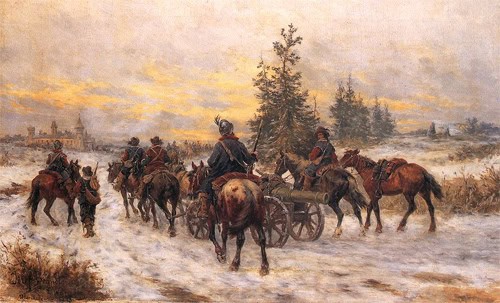
Józef Brandt, The March of the Swedes to Kiejdany /pl.wikipedia.org/wiki
The Swedish Deluge: 370 years later
In 2025, we mark exactly 370 years since the outbreak of the Polish–Swedish War, commonly known as the ‘Deluge.’ Why did it happen? How did the Polish–Lithuanian Commonwealth find itself almost defenceless in the face of invasion? And how did Poland ultimately manage to repel the attackers? Historian Patryk PALKA explores these questions.
The Polish-Swedish War of 1655 erupted from a complex interplay of military strength and economic hardship. One side boasted a formidable army but faced financial difficulties, while the other possessed valuable territories and had demonstrated significant vulnerability in the years leading up to the conflict. Notably, this war was not initially rooted in a dynastic dispute within the Vasa dynasty. Instead, it revolved around the critical control of the Baltic Sea and trade routes, as Sweden sought solutions to its economic woes. The Swedish military, the most powerful in Europe at the time, had been developed to address the demands of the Thirty Years’ War (1618-1648), and by the 1650s, it required a new purpose. Meanwhile, the Polish-Lithuanian Commonwealth was struggling to manage the ongoing Khmelnitsky Uprising, which had begun in 1648. With the Cossacks and Tatars presenting formidable threats, how could the Commonwealth hope to withstand the might of the Swedish army? Compounding their challenges, the Polish-Russian War had already commenced in 1654, placing additional pressure on the Commonwealth. Sensing an opportunity amid its neighbour’s weakness, the Tsarist state aimed to gain from the unfolding chaos. Furthermore, George Rákóczi, Prince of Transylvania, encouraged Swedish aggression by offering military support and the prospect of partitioning the defeated Commonwealth. Thus, by 1655, the geopolitical landscape was decidedly favourable for Sweden.
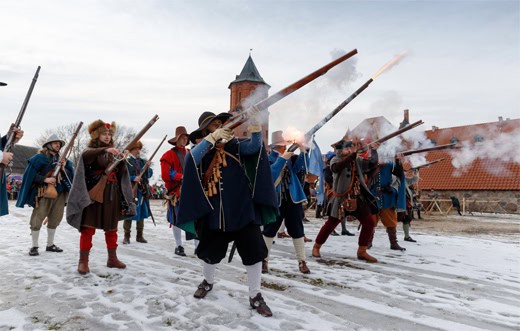
Reconstruction of the assault on the castle in Tykocin during the Swedish Deluge PHOTO Anatol Chomicz Forum-0436187074
As Swedish forces crossed into the Polish-Lithuanian Commonwealth in the summer of 1655, it quickly became apparent that there was a lack of widespread conviction in the nation’s ability to defend itself. The mobilisation of the Greater Poland nobility crumbled at Ujście without a fight, and Lithuania effectively severed ties with Poland, surrendering to the Swedish king. King John II Casimir endeavoured to organise a defence of Polish lands, but betrayal from both Greater Poland and Lithuania, coupled with ongoing conflicts with Cossacks and Moscow in the east, severely limited his options. By autumn, he fled to Opole Silesia. The Swedes advanced southward, capturing Warsaw and then Kraków, as more dignitaries pledged allegiance to Gustavus Adolphus, ready to accept him as Poland’s new monarch. By late October, the hetmans of Lesser Poland capitulated, leaving the country largely under Swedish control.
However, the Commonwealth did not succumb to the overwhelming tide of the 'deluge’ for two pivotal reasons. First, the international landscape shifted, as did the resolve of Poles and Lithuanians toward defensive warfare. The looming threat of the Commonwealth’s collapse and the ascendance of Swedish power alarmed other European courts. The Tatars allied with John II Casimir, launching offensives against the Cossacks, while Moscow agreed to a truce with the Commonwealth and initiated hostilities against Sweden. Gdańsk, still valiantly resisting and crucial for controlling Pomerania, received assistance from the Dutch, who were opposed to Swedish dominance over the Baltic. Additionally, Emperor Ferdinand III pledged support for the Polish-Lithuanian Commonwealth. These developments unfolded in 1656, and the following year, Denmark declared war on Sweden, forming an alliance with Poland.
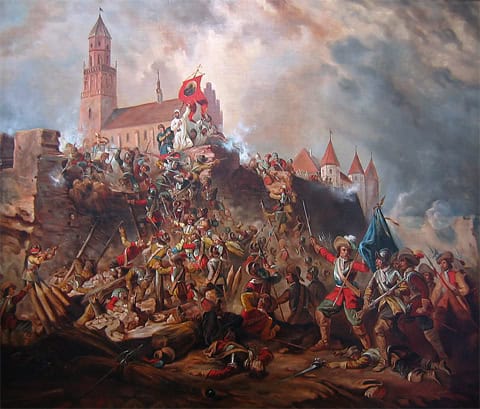
The Siege of Jasna Góra /pl.wikipedia.org/wiki/
These favourable developments were largely attributable to the diplomatic endeavours undertaken by John II Casimir’s court. At the close of 1655 and into early 1656, the king returned to Poland and began reorganising its defences. His decision was significantly influenced by the renewed fighting spirit of his subjects, especially after the successful defence of Jasna Góra in December 1655. The crown hetmans established the Tyszowiec Confederation, pledging loyalty to John II Casimir and resolving to combat the invaders. In the ensuing months, an increasing number of nobles who had previously defected to the enemy returned to the Commonwealth, both Polish and Lithuanian. Ultimately, a united army emerged, emboldened by a shared belief in the righteousness of their cause and confidence in eventual victory. Initial successes on the battlefield soon followed.
Nevertheless, the fate of the Polish-Lithuanian Commonwealth was not determined by a single decisive battle. Over the subsequent years, numerous skirmishes occurred with varying levels of success. However, Sweden could not sustain its campaign against the united Polish-Lithuanian forces, bolstered by support from imperial, Dutch, and Tatar allies, while simultaneously facing potential conflicts with Russia and Denmark. Gustavus Adolphus overextended his ambitions and ultimately faced defeat.
The war persisted until 1660, concluding with the signing of a peace treaty on May 3 in Oliwa. This conflict stands as one of the most devastating in Polish history until the onset of World War II. When combined with the Khmelnitsky Uprising and the renewed war with Moscow during the 'Deluge,’ it resulted in a significant shift in the position of the Polish-Lithuanian Commonwealth, which transitioned from a subject to an object of international politics in the late 17th century. The nation descended into economic despair, with its population plummeting by approximately 30-40 per cent, and the wealth looted during this tumultuous period remains unrecovered to this day.
Patryk Palka
Source: DlaPolonii.pl


